
Painful Intercourse: Insight into the Unspoken Barriers to Pleasure
Dyspareunia or painful intercourse, is a term used to describe barriers to penetrative sex that result from pain in the vulva, vagina, uterus, or pelvic region. This pain can come as a product of many alterations in the body including infection, pain conditions, muscle contractions, dryness, allergies, and fluctuations in hormones. According to the Cleveland Clinic, ten to twenty percent of people in the U.S. will experience internal or external vaginal pain during their lifetime. The Washington Post cites this study, which concluded that about 40% of women globally will experience some sort of sexual dysfunction, including pain during sex. Still, this experience is infrequently discussed in the media and stigmatized even within personal relationships.
In the U.S., many young people are raised with little formalized sex education and come to understand intercourse as a practice that should come naturally as an inherent biological instinct. Those who feel like they are unable to meet this standard and struggle physically with penetration experience shame and embarrassment, often hiding their experiences from others. Because of this, young women, in particular, may feel as if something is “wrong” with them when they are actually experiencing something extremely common.
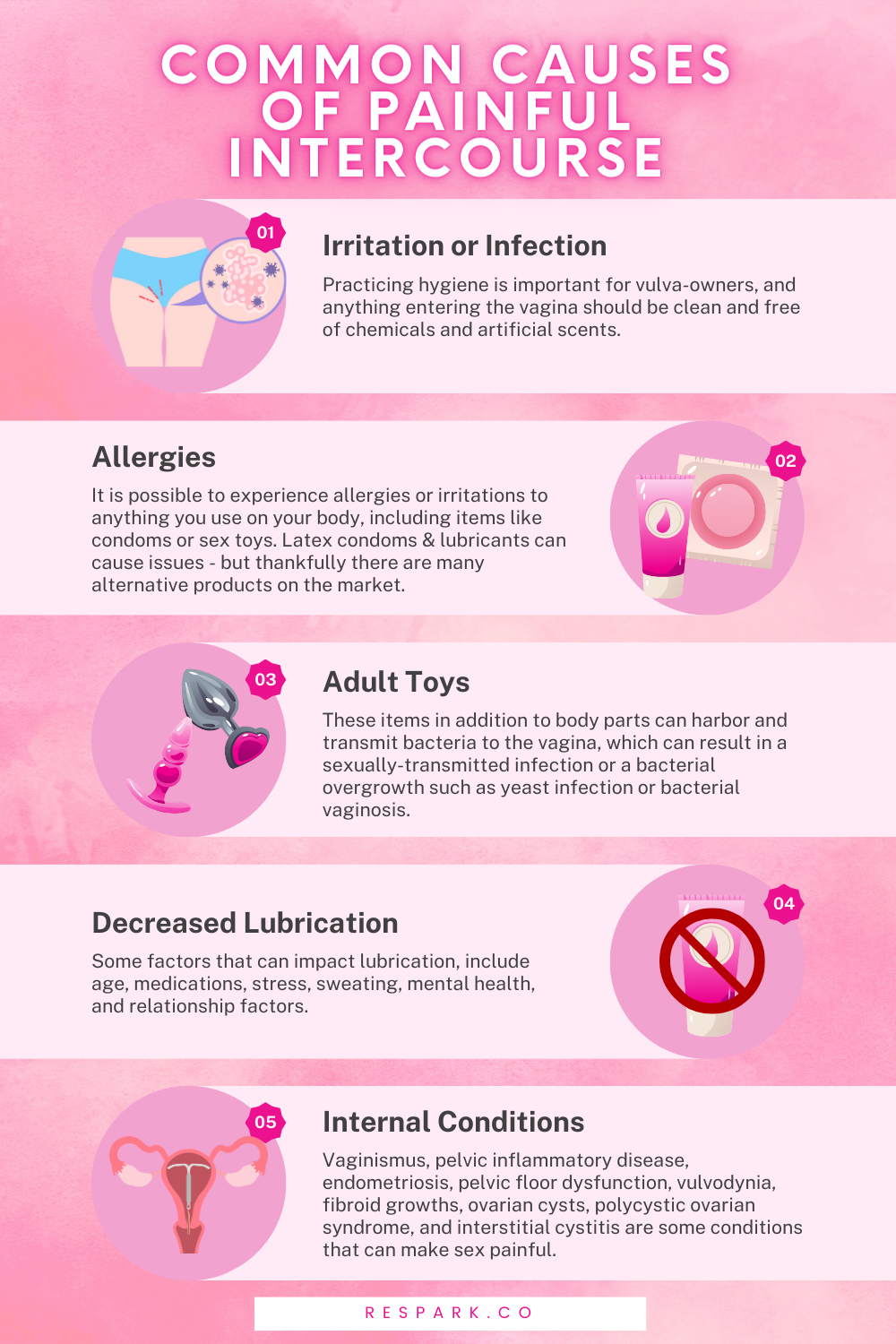
What causes painful intercourse?
Hygiene
Of all the potential causes of painful sex for vulva owners, the most common is irritation or infection of the vulva and/or vagina. The vulva is the external part, which includes the inner and outer labia, and the vagina is the internal organ that spans from its entrance to the cervix. Both parts are sensitive, but the vagina, in particular, has its own pH level which can be altered by outside contact. The vagina self-cleans to maintain its baseline pH—that’s the purpose of discharge! One’s vaginal pH can be affected in many ways; some examples include foreign items like condoms, soaps, and body parts; bacteria that can come from unwashed hands or underwear or from an internal overgrowth; and sexually transmitted bacteria and infections. Practicing hygiene is important for vulva owners, and anything entering the vagina should be clean and free of chemicals and artificial scents. When washing, you only need to use water and natural, scent-free soap on the outer part of your vulva. This part of the body really does self-clean, and all of the smells and textures are naturally occurring with no need to cover them up.
Allergies or Irritations
It is possible to experience allergies or irritations to anything you use on your body, including items like condoms or sex toys. Latex allergies are possible, but condoms do come in alternative materials such as polyurethane and polyisoprene allowing those with allergies or irritations to continue practicing safe, pleasurable sex. Lubricants can also irritate the vagina, and it is recommended to use natural, scent-free water-based lube that has a pH level close to 4.5 for vaginal contact. This list from Cosmopolitan has some great options if you’re in the market for a new lube! It is also possible to experience irritation from sex toys, so look for body-safe silicon products and wash them the same way you would wash your vulva. These items in addition to body parts can harbor and transmit bacteria to the vagina, which can result in a sexually-transmitted infection or a bacterial overgrowth.
Infections
Yeast infections and bacterial vaginosis are examples of such infections, usually developed from bacteria already present in your vagina that have overtaken the “good” bacteria. Symptoms can include itchiness, pain and burning sensations, odorous discharge, and general discomfort. Similarly, these symptoms can be a sign of sexually transmitted diseases that affect the internal body like chlamydia and gonorrhea. Luckily, all of these infections can be treated by a course of antibiotics. Less treatable infections like genital herpes can also create uncomfortable sex, which is why it is so important to use barrier methods of protection and get tested regularly.
If your symptoms are new or worsening, and especially if you have a new partner, you should seek testing from a clinic or gynecology office. The nurse or doctor will likely check for visible signs of STDs and infections, as well as run swab tests to determine the cause of your symptoms. Most infections are highly responsive to antibiotics and treatment, so if this is the cause of your painful sex, you should feel a difference within a few weeks. Of course, these infections are transmissible (yes, even yeast infections!) so abstain from vaginal sex until your treatment is finished.
Decreased Lubrication
Infections are not the only cause of painful sex; in fact, decreased lubrication is one of the most common contributors. This is also referred to as “wetness” or “getting wet” during sex. Every vagina will have a slightly different “normal” for lubrication, but generally speaking, cervical and vaginal glands secrete a liquid that coats the vaginal walls in preparation for penetration. This may correlate to feeling “turned on,” but it doesn’t always; rather, it is a biological response to any number of signals that sex may occur. Healthline also lists some factors that can impact lubrication, including age, medications, stress, sweating, mental health, and relationship factors. Perhaps the largest factor is hormone level, which can fluctuate within a cycle but also throughout the lifetime of a menstruating person. Menopause, the ending of fertility that correlates with one’s final period, is the time in which the body’s production of hormones like estrogen fluctuates greatly, leading to symptoms like hot flashes, mood changes, and vaginal dryness.
There are a few treatment options for vaginal dryness related to menopause. Many people find relief in natural, water-based lubricants as those discussed earlier. There are also estrogen-based creams and suppositories available over-the-counter that can stimulate the production of lubrication within the vagina. While these are hormonal options, the hormones are contained in the vagina itself, as opposed to the birth control pill which circulates through the bloodstream. According to the National Institute on Aging, two non-hormonal prescription treatments have been FDA-approved: ospemifene and prasterone, which are available through talking with your doctor. Changes in dryness can also come when transitioning birth control methods, and other changes that alter your hormone levels. Some people on medications such as SSRIs (selective serotonin reuptake inhibitors, also known as antidepressants) find that their ability to sufficiently self-lubricate is inhibited as well, causing discomfort during sex. It can be frustrating to experience these physical changes, especially when they affect your sex life and intimacy, but trying treatments and lubricants can be a great way to get your body back on track.
Internal Conditions
The last major category of factors that contribute to painful sex is internal conditions. There are several conditions, both in the pelvic region and elsewhere in the body that can cause decreased lubrication, muscle tightness, and overall pain and discomfort during sex. These conditions can sometimes be more difficult to identify and treat than their more obvious counterparts, like bacterial infections. According to the NHS, pelvic conditions include vaginismus, pelvic inflammatory disease, endometriosis, pelvic floor dysfunction, vulvodynia, fibroid growths, ovarian cysts, polycystic ovarian syndrome, and interstitial cystitis. Vaginismus and pelvic floor dysfunction both consist of involuntary muscle contractions that make penetration extremely painful; vaginismus involves the muscles at the vaginal opening while pelvic floor dysfunction involves the pelvic floor muscles, the same ones that are used to prevent bladder incontinence. Pelvic floor injuries and pelvic inflammatory disease affect this same region, making internal stimulation uncomfortable. Vulvodynia operates in the same region as vaginismus, serving as a chronic source of pain in the vulva which makes the vaginal canal impossible to enter, even with tampons and menstrual cups. Endometriosis is among the more common of these conditions. Here, uterine tissue grows in other areas of the pelvis, causing pain in those locations. Similarly, fibroid growths and ovarian cysts develop in the uterus and ovaries respectively, causing pain in these regions. Polycystic ovary syndrome, or PCOS, is an imbalanced production of the male hormone androgen from the ovaries, which can also result in cystic production.
There are also internal conditions that operate outside the reproductive system yet affect sexual practice. One example is interstitial cystitis, which is a syndrome where the bladder becomes inflamed. This condition, as well as infections within the urinary tract, bladder, and kidneys, can all make penetrative sex uncomfortable and painful because of their close proximity to the vaginal canal. Many of these infections can be treated quickly with antibiotics, similar to the vaginal infections discussed earlier. Additionally, rectal and bowel issues can cause discomfort during sex, particularly IBS (irritable bowel syndrome) and constipation. With all of these internal organs existing within the same small section of the body, overlap in pain and inflammation can make penetration difficult.
Mental, Emotional, and Psychological Blocks
Much less studied but still, prevalent causes of painful sex include mental, emotional, and psychological blocks. Such symptoms can arise for a myriad of reasons, though one such example is past sexual trauma. The tightening of muscles around the pelvis and vagina can serve as unconscious trauma responses in the name of self-protection, even if you aren’t intentionally doing so. Mental health-related conditions such as anxiety and post-traumatic stress disorder can have similar effects on the body, tightening muscles and making penetration difficult and painful. These conditions can increase dryness in the vaginal canal as well.
Is there a solution to painful intercourse?
With the multitude of potential causes behind painful sex, it can be difficult to find the right course of action to bring the body back to a state of pain-free pleasure. For many of these causes, there is no one foolproof way to “cure” the symptoms – at least not yet. For some, particularly endometriosis and other conditions with swelling, pain relief medications, and anti-inflammatory drugs can help to mitigate the symptoms. An invasive surgery called a laparoscopy can actually cure endometriosis, but it can be a strenuous procedure. Dryness and certain conditions like ovarian cysts that are due to changes in hormones can be improved by hormone therapy, most commonly through prescription pills. For infections, probiotics are a great preventative measure to build up the healthy bacteria in your body and support your immune system to fight off infection. Products like CBD-infused lube have also been known to have positive effects on vaginal wetness and muscle relaxation.
There are also alternative medicine solutions for these conditions, including therapy and meditation. It can be difficult to discern the root cause of painful sex in some cases, but psychological intervention can be a great starting point for understanding your symptoms and their causes. Cognitive behavioral therapy and sex therapy are the most common starting places for sexual dysfunction, but there are also more specific options to explore based on what works for you and your body. Blue Heart describes the practice of sensate focus therapy, a subset of sex therapy, as the practice of mindful touch between partners. Pelvic floor physical therapy can be beneficial as well, especially for those experiencing pain due to muscle tightness and contractions in the pelvic region, sometimes related to sexual trauma. Gynecologists may recommend a practice like this if a patient is unable to resolve their painful sex with other measures. Finally, practitioners may recommend meditation exercises to relax the muscles and refocus on your own sexual desires, with the goal of increasing mindfulness and creating a more positive relationship with sex.
If you’re looking for a qualified sex therapist or coach to help you with painful intercourse, you have come to the right place. Respark Therapy has sex therapists trained to help you overcome mental, emotional, and/or psychological blockers preventing you from having pain-free intercourse. Our therapists in Colorado, Texas, Utah, Washington, and Missouri and worldwide coaches are here to help you.
Conclusion
While it can be difficult to have these conversations, they are integral to fostering a supporting, education-based world of sex. Without them, young people and young women, in particular, grow up conforming to sex practices that not only decenter their sexuality but also enforce that their pleasure is secondary to their partner’s. Dr. Karyn Eilber, a urologist at Cedars Sinai, says, “I think as women, we often tend to blame ourselves. That can definitely contribute to the pain and to sexual dysfunction. I think the more resources we can make available, and the more we’re able to talk openly about these issues, the more beneficial it will be.” Our mission at SHA is to continue these conversations and remind those reading that they are not alone and that nothing is “wrong” with them. There are so many ways to practice intimacy and have sex without penetration, but there is no shame in wanting to ask for help so that you can have the fullest experience you desire.
By Sydney Sullivan