
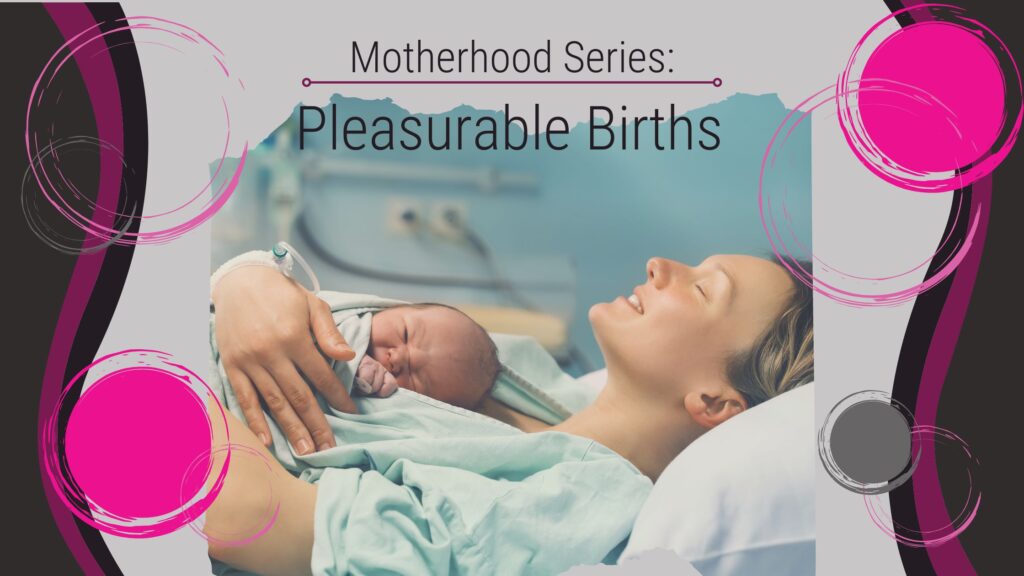
Motherhood Series: Pleasurable Birth
The experience of labor and delivery can be described as many things, but “pleasurable” is probably not high on the list of associated adjectives. However, as in everyday life, the act of experiencing and squeezing pleasure out of mundane or even painful experiences can be a radical act. Along with the other recommended grounding techniques commonly offered to soon-to-be mothers (i.e., breathing exercises, movement), orgasming seems to be an overlooked, natural method for pain relief and vaginal stimulation. What’s more, this stimulation has the ability to actually speed up the labor process, allowing for more time spent in bliss with your baby, and less in the heat of the moment (see the “ring of fire,” if you’re unfamiliar). By creating nuance in the intersections of the hardships of birth with the pleasures of orgasm to create a pleasurable birth, your body is able to hold space for multitudes of feelings and emotions at once, deepening your connection with the experience. In exploring these intersections, understanding the benefits of orgasm to the onset of labor is necessary to be able to build on this stimulation during active labor.
For centuries, women have found sexual acts to be helpful in inducing labor. Physiologically, because the cervix must ripen before a baby can be birthed, stimulating this area sexually can aid in the speed and depth to which this occurs naturally. The best part is that this type of stimulation is also natural, so there is no need to involve the healthcare provider until induction has actually occurred. Methods for this include nipple play, cunnilingus, and intercourse, among other things – when in doubt, consider doing the same sorts of acts you did when conceiving the baby. While these methods might not necessarily lead to spontaneous labor, engaging these vaginal and uterine muscles can only help, and very rarely hurt, the birth process. Ultimately, relaxing into your own body, being present, and feeling all the sensations can allow your body to take control of the process, while you guide the way.
Once induction is underway, the capability for pleasure doesn’t end. There are two general experiences of women experiencing orgasm during labor: the “Unexpected Birthgasm” and the “Passionate Birth.” In the former, women reach climax without actively trying or envisioning that experience. This can occur during the pushing process, whereby the mother somewhat accidentally becomes aroused while delivering her baby. The simple fact that this naturally occurs without intervention serves as proof that orgasms and birth do, in fact, fit together. The real question then becomes, how and under what circumstances can orgasm be achieved during childbirth?
Typically, study respondents experiencing a “Pleasurable Birth” experience reported a high sex drive before their deliveries and generally an open, sex-positive attitude, which could point to the idea that being sexually liberated encourages engaging in sexual acts during labor. Moreover, preparing for a pleasurable birth can tip the scales in the mother’s favor. This preparation might include tantric practice, birthing place (e.g., in water), birthing position practice (e.g., hands and knees), breathwork, or sound therapy (e.g., “om-ing”). Being connected to your body before birth guides your connection with your body during birth. Allowing yourself the space for pleasure is then the gateway to orgasm used as pain relief and presence assertion (e.g., tub or shower, dimmed lights, music, massage, birthing ball).
This pain relief is achieved due to the activation of certain hormones and the nervous system. Oxytocin, beta-endorphins, and adrenaline create a cocktail of pleasurable feelings. Because of the fact that these hormones are stimulated both during childbirth and sexual activity, their combination can lead the mother to an “altered state of consciousness” during birth. Meanwhile, the hypogastric and the pelvic nervous system are also stimulated when pushing, and these systems can create a sensation of relief. When building on this relief, orgasm may be achieved. As these signals and hormones radiate throughout the body, birthing pain is relieved, and contractions may increase in timing and intensity, leading to an overall easier birth experience.
This area is admittedly underresearched as Western views on childbirth and sexuality inform the labor experiences of women in developed countries. When met with conservative-based barriers such as the lack of privacy, feelings of security, and body negative attitudes, orgasming during birth can seem impossible. But this is precisely why the practice is so important. Positioning pleasurable births through a feminist lens offers a new way to connect to the radical notion of power dynamics within the healthcare field. Being both physically and emotionally present in a sometimes uncomfortable setting allows the mother to take her power back during childbirth, claiming the experience as her own despite traditional viewpoints. In this way, we may learn from other cultures, birth workers, and advocates that labor is multidimensional and each experience holds the possibility for pleasurable opportunities. This is the core of birth justice, the orgasm is just the cherry on top.
By Emily Carriere