
ADHD and Codependency: Essential Tips for Building Healthier Boundaries

Ever felt like you’re walking a tightrope in your relationship, balancing the challenges of ADHD and codependency? You’re not alone. For many, these two dynamics create a unique push and pull that tests boundaries and impacts intimacy. But here’s the good news: with the right tools and strategies, you can break the cycle and build a healthier, more balanced partnership. Ready to learn how?
When we talk about ADHD, most people think of symptoms like impulsivity, hyperactivity, or forgetfulness. Codependency, on the other hand, brings up images of self-sacrificing behaviors, lack of boundaries, and reliance on external validation. But when these two patterns overlap in a relationship, they can create a complex cycle that impacts communication, boundaries, and emotional stability. If you or your partner struggle with both ADHD and codependency, navigating boundaries in a relationship can feel even more challenging. The good news? With a skilled therapist, you can develop the tools to manage these dynamics effectively and foster a healthier, more balanced partnership.
Understanding the Connection Between ADHD and Codependency
It may not seem obvious at first, but ADHD and codependency often share common ground. People with ADHD sometimes rely on their partners for support with things like organization, focus, and stability. In codependent relationships, one partner might take on a “caretaker” role, feeling compelled to help their partner in ways that can, over time, feel draining or unbalanced. This dynamic can unintentionally build an unhealthy reliance, where one partner feels the need to “fix” or manage the other, creating a lack of boundaries that can impact both partners’ sense of autonomy.
Take, for example, a couple—let’s call them Sam and Jamie. Sam has ADHD and often relied on Jamie to help manage the day-to-day tasks that felt overwhelming. Jamie, in turn, loved feeling needed and found purpose in organizing Sam’s life. Over time, though, Jamie began to feel frustrated, and Sam felt guilty for relying on Jamie so much. They were both stuck in this loop of dependency, which affected the intimacy and respect in their relationship. It took recognizing the problem and committing to boundary work in therapy to help them start building a healthier dynamic.
How ADHD Affects Boundaries
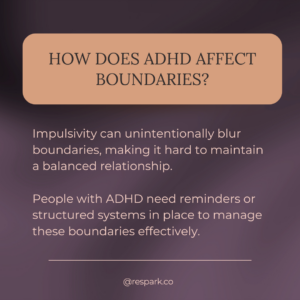 ADHD can make setting boundaries tricky. Due to impulsivity, people with ADHD may struggle to recognize where they need boundaries, often agreeing to things without considering how they affect their well-being or time. This impulsivity can unintentionally blur boundaries, making it hard to maintain a balanced relationship. It’s not uncommon for people with ADHD to need reminders or structured systems in place to manage these boundaries effectively.
For Sam, recognizing that saying “no” was okay was a turning point. Many with ADHD struggle with people-pleasing behaviors, a tendency that overlaps with codependent patterns. But healthy boundaries allow relationships to thrive, creating a space where both partners feel valued, autonomous, and respected.
How Codependency Impacts Boundaries
Codependency can lead to blurred lines between support and over-involvement. In a codependent relationship, it’s easy for one person to take on a “helper” role, even to the detriment of their own well-being. Often, this partner may feel anxious if they aren’t “needed” and may go out of their way to help their partner avoid negative consequences.
In Sam and Jamie’s case, Jamie found it difficult to let Sam manage responsibilities independently. This need to “rescue” Sam created an imbalance that ultimately harmed their relationship. It wasn’t until they sought therapy and began to understand the impact of these behaviors that they could work toward healthier, more independent identities within the relationship.
Why Couples Therapy Can Be a Game-Changer for ADHD and Codependency
Seeking help from a couples therapist can be incredibly beneficial for couples struggling with ADHD and codependency dynamics. Therapy offers a safe space to address patterns that may feel too difficult to manage alone. Through therapy, both partners can develop a more profound understanding of each other’s needs, recognize unhealthy dynamics, and begin to establish boundaries that honor each person’s individuality.
ReSpark Therapy: A Top Choice for Couples Therapy
If you’re in Austin, Texas, ReSpark Group is a leading option for couples therapy. Known for their expertise in working with individuals and couples facing complex relational dynamics, ReSpark’s therapists are trained to help clients navigate the unique challenges that ADHD and codependency bring. Their approach emphasizes compassionate communication, boundary-setting, and personal empowerment, making them an ideal choice for couples who want to transform their relationship dynamics.
With ReSpark’s team, you’ll find therapists who understand the nuances of both ADHD and codependency and who can help you work toward healthy, sustainable boundaries. Each therapist at ReSpark takes a tailored approach to every couple’s needs, ensuring you receive the right tools to address your unique challenges and strengthen your relationship.
Essential Tips for Building Healthier Boundaries
 1. Identify and Communicate Needs
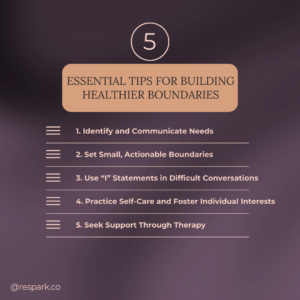 1. Identify and Communicate Needs
The first step in boundary-setting is understanding your own needs. Both partners should feel encouraged to reflect on what they need in the relationship. Someone with ADHD, for example, might need reminders and support in organizing tasks, but it’s crucial to communicate this openly. A therapist can help you both explore these needs and find ways to meet them without falling into a dependency loop.
A common tool used by ReSpark therapists is the “needs inventory,” which helps couples identify specific emotional and practical needs. By communicating these openly, both partners gain a clearer sense of where boundaries may be necessary.
2. Set Small, Actionable Boundaries
Building boundaries doesn’t mean drawing a hard line overnight. Start with small, actionable steps, like agreeing to spend time independently once a week, or designating “unplugged” time where each person focuses on their personal interests. These small boundaries foster a sense of autonomy and remind both partners that it’s okay—and healthy—to have space outside the relationship.
Sam and Jamie, for instance, decided to try scheduling separate downtime. At first, it felt strange for Jamie to step back, but over time, they realized how important it was for Sam’s growth and independence. ReSpark’s therapists helped guide them through this, reinforcing that setting boundaries is about supporting the relationship, not creating distance.
3. Use “I” Statements in Difficult Conversations
One of the simplest but most powerful tools for building boundaries is using “I” statements when discussing needs or concerns. Instead of saying, “You never follow through,” try, “I feel overwhelmed when I take on too much responsibility.” This approach reduces defensiveness and helps both partners express themselves without placing blame.
A certified couples therapist at ReSpark can coach you through these conversations, offering strategies to create productive dialogues that prioritize empathy and understanding.
4. Practice Self-Care and Foster Individual Interests
Codependent relationships often lack a sense of individuality, which can stifle personal growth. By encouraging each partner to pursue their own interests, the relationship becomes more balanced. Whether it’s taking up a new hobby or spending time with friends, these activities help each partner nurture their own identity.
For someone with ADHD, this can also mean creating a personalized self-care routine. Therapy at ReSpark can provide the guidance and support needed to establish self-care practices that respect each person’s boundaries and needs.
5. Seek Support Through Therapy
Building and maintaining boundaries can be challenging, especially when dealing with ADHD and codependent dynamics. Having the support of a therapist can make all the difference. Couples therapy at ReSpark Group is tailored to help you develop practical tools for boundary-setting, improving communication, and understanding each other on a deeper level.
In therapy, couples can work through exercises that foster empathy, discuss personal boundaries, and create plans to keep each other accountable in the boundary-setting process. ReSpark’s therapists know that navigating ADHD and codependency is a journey, and they’re committed to providing the skills and insights needed to make lasting changes.
Final Thoughts: Choosing Healthy Boundaries for a Balanced Relationship
 If you’re dealing with ADHD and codependency in your relationship, it’s essential to remember that change is possible. Boundaries are not about keeping each other at arm’s length but about fostering a healthier relationship where both partners feel valued, respected, and autonomous. With the right support, you can build a relationship that honors both your connection and your individuality.
ReSpark Group is here to help you navigate this journey. With their expertise, compassionate approach, and dedication to helping couples grow, ReSpark is uniquely positioned to support you in creating the relationship you both deserve. Start building healthier boundaries today, and take the first step toward a more balanced, fulfilling partnership.
Take the first step towards a brighter future with Respark Therapy. Click now to take our ‘Which Respark Therapist is the best fit for you’ quiz and find out which of our expert providers is your ideal match!