

A Sex Therapy Lens: Cognitive Behavioral Therapy
Sex therapists employ various techniques and theoretical lenses when working with diverse populations. Counseling theories are important for sex therapists to base their treatment off of as they serve as a guide to help us help you better understand your experiences. Many sex therapists combine lenses and the interventions that are associated in order to tailor the therapeutic experience to your personalized journey. One of these lenses is Cognitive Behavioral Therapy (CBT). Discover what CBT is, its principles, and how sex therapists expertly weave it into their practice in this illuminating blog!

What is CBT
Brief overview: CBT is an evidence-based theory created by Aaron Beck, that derived from traditional behavioral therapies. CBT has been scientifically studied for its purpose in treating many psychological disorders, including sexual dysfunctions, depression, anxiety, OCD, and more. CBT is highly regarded as one of the most effective treatments for mental health struggles therapists work with. Let’s break down the name Cognitive-Behavioral Therapy and investigate its tenets!
-
- Cognitions: The definition of cognition is “The mental action or process of acquiring knowledge and understanding through thought, experience, and the senses”. In simpler terms, a cognition is a thought. CBT follows the psychological principle that suffering, in part, is based on faulty or unhelpful ways of thinking. Therefore, one of the main goals of CBT is to create change in your thinking or cognitive patterns.
- Behaviors: The second piece of CBT is the behavioral component. CBT specialists view clients from the lens that their behaviors are a learned response to their environment. This means all actions you engage in are based on your personal learning experience, including unhelpful behaviors that are unhealthy.
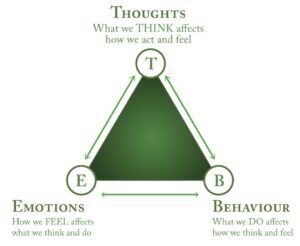
- Emotions: While not listed in the name, CBT also focuses on the emotional component of your experience. We like to think of CBT as a triangle, as our cognitions will encourage various feelings, in which we then act upon. The emotional component is viewed as a trilateral aspect as our thoughts impact our feelings, our feelings impact our thoughts, and our behaviors impact our feelings as our feelings may cause our behaviors.

CBT Treatment
Distorted Thinking: Now that you have an understanding of what CBT refers to, now let’s get into how sex therapists utilize this theoretical perspective. Treatment via CBT includes reflecting on your current thinking patterns and recognizing how they are affecting your choices. When working with sex therapy clients, unhelpful thinking patterns play a huge role in how you view your sexual activity. Some examples of unhealthy cognitions regarding your sexuality include:
- “I am bad at sex”
- “My body is broken”
- “I am never going to feel pleasure”
These examples display the negative viewpoint you may have towards your sexual experiences. A sex therapist will explore the root of your individual beliefs and thoughts, and work with you to reframe your distorted thinking patterns. A reframe of these cognitions may look something like:
- “I am inexperienced at sex and want to explore more.”
- “My body likes other sensations.”
- “I haven’t experienced my best sexual experience yet.”
Addressing these cognitions is huge in CBT, as you can witness the negative thinking patterns impact how you engage in your world.

Behaviors: Not only do CBT therapists inspect your thoughts, but also the behaviors that derive from those negative cognitions. Changing your behavioral patterns with a sex therapist involves replacing those unhelpful movements in life with more healthy and positive actions. Based on our examples, you can witness the difference in courses of actions that may take place in response to the different ways of thinking. If you believe you are bad at sex, you may halt your sexual activity, shy away from any sexual encounter, have an absence of intimacy, and so on. However, when you view your experiences from a healthy way of thinking, including compassion, you will have different behavioral outcomes. Healthy ways of thinking will promote more communication around sex with your partner(s), hopefulness in exploring other ways to be intimate, learning new ways to feel pleasure, and navigating your sexuality without judgment.
Fret not! You do not have to gain the awareness of your cognitive distortions or your unwanted behaviors alone. Sex therapists work with clients in order to become the person they have set out to be. With CBT’s tenets of psychoeducation, practicing techniques, and providing homework, a sex therapist will walk with you through the journey of recreating your best self. Interested in receiving cognitive behavioral therapy with a professional? Book with a sex therapist today to unlock your sexiest, most fulfilling way of being!