
Pleasure Activism: Book Review and Recommendation
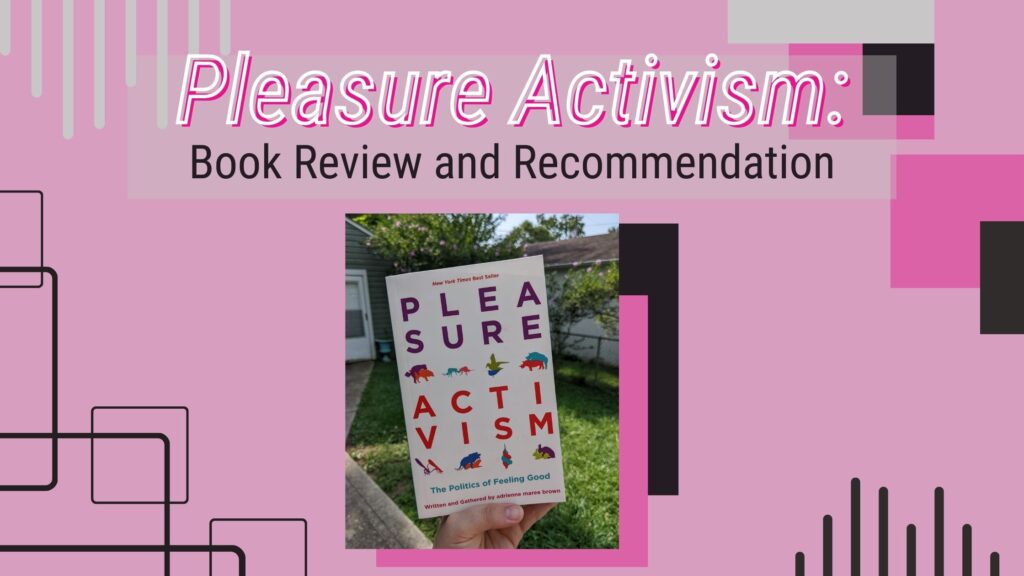
adrienne maree brown’s 2019 book Pleasure Activism: The Politics of Feeling Good surrounds the radical notion that experiencing pleasure under the current power regimes is inherently a revolutionary act. This is a fascinating concept to me because it builds joy into the activism landscape, meaning that to create sustainable change for all, we need to allow space for feelings traditionally connotated as selfish. I tend to think about this in terms of avoiding burnout when fighting for justice. I think all of us are familiar with the feelings of anxiety, overwhelm, and sadness that builds following repeated offenses reported by the news. But amb takes this even further to pose that simply existing joyously and with surroundings that feel sensual is radical. Consider, momentarily, the feelings power structures such as capitalism, patriarchy, and systemic racism want you to experience on a day-to-day. Is it happiness and sexual power? Likely not. This is because feelings of pleasure likely remind us of our human-ness, which is antithetical to our production capability. On the other hand, feeling stressed, trapped, and oppressed keeps us complacent with these systems, and always working for the weekends, for example. The capitalist-patriarchal-racist system will simply then re-sell your happiness back to you in the form of merchandise or lavish vacations. amb seems to think that we can reclaim this re-sale, though, by refusing to use them as coping mechanisms and instead use them as daily practices in spite of institutional injustices.
amb’s book is organized into multiple short stories, some written by herself, some written by her mentors, friends, and colleagues. Stories cover a range of topics from sex to drugs, from non-traditional relationships to parenting sexually-healthy children. Some excerpts even come in the form of interview as amb asks her interviewee their thoughts on a certain subject. At the end of each story, there is what amb calls “Hot and Heavy Homework” that guides the reader in a practice to transform their relationship to the topic. If you’re like me and love a good action item, this very well may be your favorite part of the book. In all, though, the book maintains a friendly, transparent tone throughout, making it a fairly easy read. Take care, though, not to rush through the book, as you might miss out on all of the thought-provoking narratives and practicable actions. I’ll admit that I have read this book several times and still find something to think on with each revisit.
amb is a self-described pleasure activist focusing on Black feminist theory and social justice. She centers herself at the intersection of political education, community organizing, somatics, and Black love. In opposition to capitalism’s commodification of the body, and for visual satisfaction, amb purposefully de-capitalizes her name. Building on her previous work in social activism and of the work of other feminists, amb develops models for action, community strength, movement building, and transformative justice.
One of the feminists amb’s work honors is the late Audre Lorde. Lorde was a Black feminist, poet, and activist trailblazing the movement of liberation for all people. Lorde is known for having combined the personal and the political spaces to create a landscape of responsibility in systemic issues. This is essentially the basis of amb’s work as she explores how and why individuals are affected by the systems around them. amb then takes this further to explain how living intentionally can disrupt these systems and push back on traditional ways of thinking.
Needless to say that Lorde’s legacy lives on in many feminists’ social justice work and writings, including amb’s starting story where she re-prints Lorde’s “Uses of the Erotic: The Erotic as Power.” This piece of classic literature frames the erotic as a means for women to subvert the patriarchal power structures that have aimed to take away our capability for pleasure as a way to keep us submissive and oppressed. In this way, the erotic represents un-tapped energy, self-love, and power. Thus, pornography, sex work, and masturbation can serve as a way to access our collective and individual power, which we can then apply to outside sources, including the structures confining us. Lorde asks us to explore these parts of ourselves in order to show up as our whole selves in liberation-based movements.
Following this excerpt, amb includes an interview entitled “The Legacy of ‘Uses of the Erotic’: A Conversation with Cara Page.” Page is a Black Queer feminist, organizer, and the former Executive Director of the Audre Lorde Project. The two discuss the history and legacy of Lorde’s iconic essay through the lens of action. In revisiting this work years later, amb and Page are able to chat about intersectionality in the context of modern-day movements. This includes making the erotic accessible to all bodies, what true self-love can look like in a sickeningly overwhelming body-positive culture, and how to reclaim sexuality after generational sexual violence.
While these two stories are just a couple of the gems amb includes in her book, I believe they perfectly signify how media can influence cultural shifts. With the work amb does, it’s clear she wants to draw a through-line between theory and practice, but this cannot be done without collective action. Beginning this social justice work is rooted in understanding, and amb does a great job of contextualizing the liberation movement. So, to start, I suggest picking up a copy of Pleasure Activism: The Politics of Feeling Good at your local book store or via SHA’s Bookshop storefront. Work through it at your own pace, find community in her words, and then utilize those lessons in your external life.
By Emily Carriere