
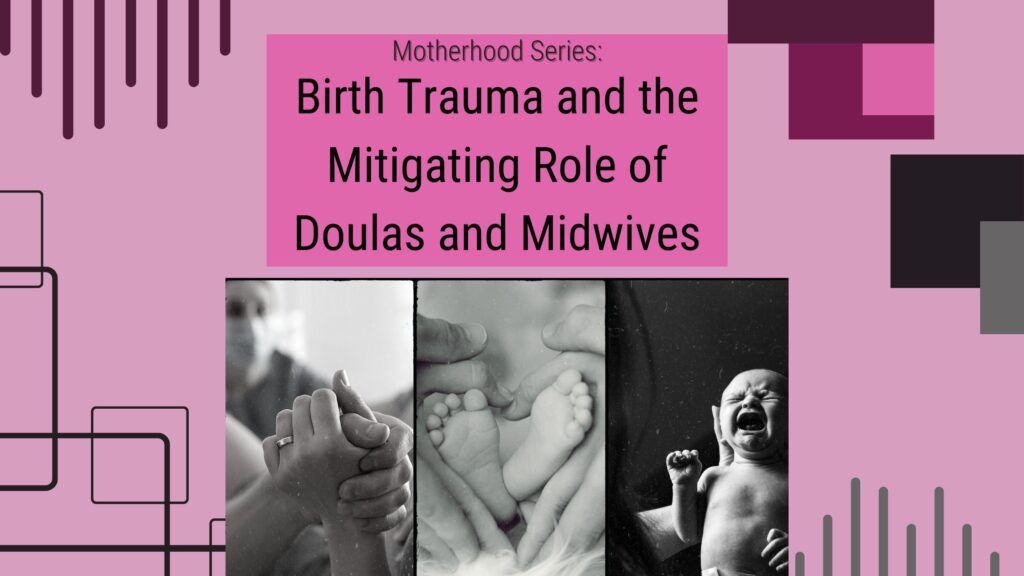
Motherhood Series: Birth Trauma and the Mitigating Role of Doulas and Midwives
While the birth of one’s child is often an empowering, positive experience, viewing all births this way limits the ability of mothers, their partners, and their children to feel and express any negative attitudes toward this momentous journey. Labor and delivery is a deeply personal and varying experience for each mother and each birth. Feeling the myriad of emotions resulting from an experience so intense and intimate is a large part of the humane condition, and recognizing these emotions in yourself, your partner, your friends, and loved ones allows for more genuine conversations to take place, and more support for new mothers to pour out from her community.
“Birth trauma” is an all-encompassing term for any harm a mother experiences when giving birth to her child. This includes birth injuries to the mother and/or the infant and any mental toll on the mother resulting from her birth experience. Thus, both physical and psychological harm must be considered and addressed to properly care for the whole of the patient and combat the systemic inequities in the healthcare system.
The most common mental harm to the mother after a traumatic birth is posttraumatic stress disorder. Penny Simkin, a renowned writer, doula, and natural birth advocate, expands this idea by explaining that birth workers themselves are often affected negatively by witnessing traumatic births. In this we find proof that the labor and delivery care system is unjustly hurting women, children, and their caretakers. This issue is further exacerbated by the fact that mental health is over-stigmatized and underfunded in our country’s society, leading to negative consequences for women attempting to access care. Preexisting mental health conditions actually serve as another risk factor increasing the likelihood of experiencing a traumatic birth. Therefore, the women worst off are also the most vulnerable to scenarios of harm.
As mentioned before, though, these women are not the only affected parties. Research suggests that birth trauma decreases the ability to form mother-child bonds, affecting both the child’s healthy development and the mother’s sense of identity. Additionally, when coupled, partners experiencing birth trauma also experience declining states of mental health, ultimately impacting the couple’s relationship. Interestingly, both parties experience this birth trauma differently, though bearing witness to the same traumatic event. Typically the partner will avoid memories or conversations about the birth while the mother will re-live those experiences again and again in daily life. For these reasons, the relationship is strained as both parties feel the weight of the birth trauma and handle their grief in almost opposite ways. This connects back to the idea that opening up a line of conversation about the range of emotions felt after such an event would allow for healing, rather than dismissal or PTSD triggers.
The causes behind birth trauma are almost as varied as the experiences themselves. Moreover, due to a lack of research done into women’s and maternal health, much is yet to be discovered in the realm of birth trauma. For this reason, no one should discount or invalidate their own experiences. With that being said, studies have shown that prolonged gestation, epidurals, prolonged labors, oxytocin, forceps, and cesarean sections are among the events that may lead to traumatic births. Further, according to the gathered experiences of midwives, lack of support systems, negative birth outcomes, and excruciating pain contribute to traumatic birthing experiences as well. Because healthcare providers are also affected by these traumatic experiences, provider decision-making might be negatively impacted by the high range of emotions and the time-sensitive nature of the experience. This points to the larger idea that the maternal healthcare system is inadequate and does a disservice to its patients. In fact, many parents in Australia have opted for home births due to the maternity system not meeting their needs for postpartum care and not offering adequate non-medicalized labor options.
Recognizing all the negative outcomes of birth trauma is only the first step in addressing the issue. In many ways, the role of birth advocates including doulas can mitigate and ease the weight of birth trauma. By practicing universal trauma-informed and trauma-targeted care, doulas can not only realize the magnitude of this epidemic, but also recognize the signs of concern, respond to those, and help their clients resist any re-traumatization. One of the major ways this is done is through simple reframing exercises (i.e., writing down the birth story within the first few weeks of birth and then again months or years later to notice comparisons across time, highlighting only the parts that really matter) to nurture and protect the mother’s memories of their birth. This reframing has been shown to improve psychosocial outcomes of birth trauma, solidifying the need for further and more accessible doula care.
These are arguably not even the most important roles doulas play. Doulas have a long history in Indigenous cultures and protecting this source of ancestral knowledge is paramount to advancing justice within the healthcare system. Peer networks of communication and support allow doulas to establish meaningful relationships and shed any negative emotions they themselves might be feeling from a traumatic birth experience. Specifically within Indigenous communities, responding in culturally-informed ways to the concerns and needs of the community while connecting personally with the mother helps to balance inequities among the larger population.
However, a hindrance to Indigenous doula care is the cost of services. Pay inequity is already a problem facing the Indigenous population, but when the work is aimed at the population itself, doulas have a more difficult time balancing the responsibilities of fair payment models and providing high-quality care to families who cannot afford their services. Built into this racially discriminative structure is the inherently Westernized need to financialize the labor and delivery process when Indigenous births are considered sacred and untied to financial burdens. This is not to say that Indigenous doulas are the only ones facing issues related to fair pay for their services – most non-traditional birthworkers find difficulty being covered by insurance, or finding clients wealthy enough to pay for services out-of-pocket. Thus, while uplifting historically excluded groups, we must also question the very system we all exist within. Supporting doula work is the first step to supporting the journey of motherhood.
In this way, the most pressing policy issues to be addressed are insurance coverage, patient-informed care, and mental health resources. By codifying and legitimizing the work of doulas, insurance companies would include this invaluable work in their coverage, allowing more women to have access to critical support and reframing. This is central to the idea of patient-informed and patient-led care. By providing patients with accurate information on their healthcare decisions, they are empowered to take control of their own health experiences and can better advocate for themselves during vulnerable periods, like during labor. This also ties into providing adequate prenatal, perinatal, and postnatal care. In acknowledging that the whole of pregnancy and labor is a time for increased screenings and support, healthcare providers and institutions could better fight risk factors and work to prevent birth trauma in the first place. In the cases where traumatic events do happen, though, mental health resources should be made readily available. Whether this is through insurance coverage or simply publicly provided resources, the advancement of mental health will always serve the mother, and that’s what this is all about: serving the mother and the newborn(s).
By Emily Carriere