
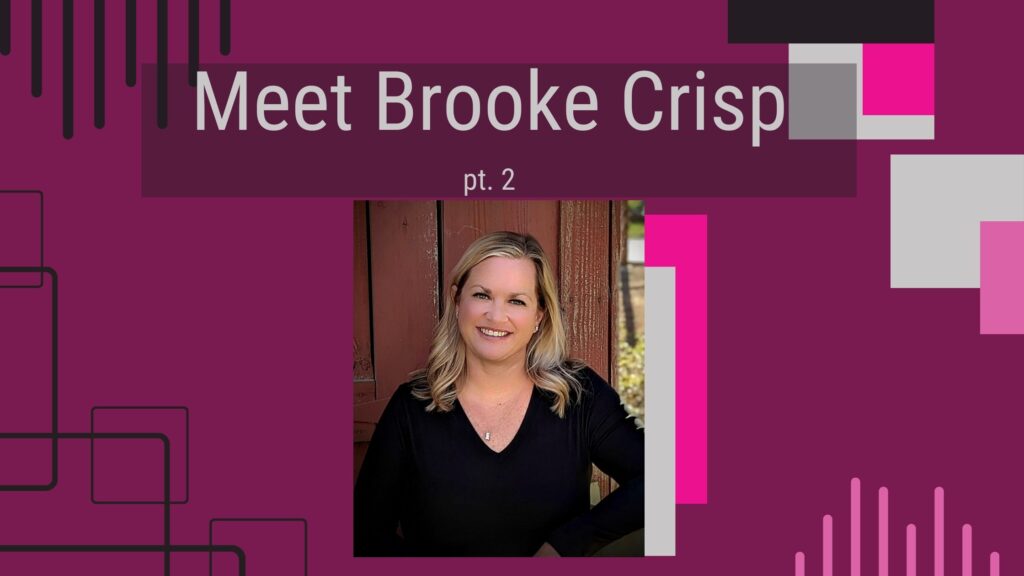
Get to Know Respark Therapist, Brooke Crisp, LPC-A – Part 2
Respark is happy to bring on our newest Respark Therapist, Brooke Crisp. Learn more about Brooke and her practices using our questions and answers below!
What is your favorite and least favorite part about being a sex therapist?
I think I could literally write a book regarding my passion and enthusiasm for being a sex therapist, as I truly believe everyone can benefit from having one! Sex therapy does not just have to be in an individual’s life when issues or struggles arise. Sex therapy should be a regular part of your overall health, like yearly check-ups, getting your teeth cleaned, vision exams, physical activity, and other wellness activities. Individuals can utilize sex therapy at any stage or transition point throughout their life. There are so many changes that take place as we age from our 20s, 30s, 40s, and beyond – it is nice to have a sex-positive therapist to hold space for you to self-reflect, accept, explore, and challenge yourself as you grow and change throughout your life and as a sexual being. Knowing that you are not alone, eliminating shame and guilt, and exploring an individual’s own values and beliefs versus what was given to them by others is why I do what I do. Providing a space for individuals to be vulnerable, honest, raw, and to grow into their own authentic sexual being with the knowledge and tools to be confident is my favorite part of being a sex therapist!
I can honestly say that I do not have a least favorite part of being a sex therapist. However, if I had to dig deep to find one downside, it would be that I do not have enough hours in my day to see clients, read all the latest research, read all the fabulous books/listen to podcasts on sex-related issues, and share/shout my passion for positive sexual health from the rooftops for everyone to hear! One goal I have as a sex therapist is to continue to destigmatize the subject of sexual health and seeking sex therapy and encourage individuals to make their sexual wellness just as important as their physical health.
What is something you wish you knew before becoming a sex therapist that you would like to share with others embarking on this journey?
I would tell anyone wishing to become a sex therapist that it takes a lot of work. The work includes embarking on your own therapeutic journey to address your own issues, struggles, and conception of sexuality. It is through this experience that you gain a deeper understanding of vulnerability and self-discovery, and experience for yourself the journey you are asking your clients to embark upon with you. The discovery of personal biases, values, family systems, and issues that unfold within therapy can run deep, be extremely emotional, and become life-changing. Your personal therapeutic journey allows you to develop your own values and belief system from within yourself. There is a tenderness you experience from a positive therapeutic relationship with your own therapist that permits and encourages your own vulnerability, which in turn deepens your capability to provide an authentic, non-judgmental, and empathic space for your own clients.
Tell us about yourself and your career as a therapist and how you specialized to see couples and sexual health issues.
Upon completing my undergraduate degree, I began working as a Child Life Specialist with pediatric patients in the hospital setting. This included providing social and emotional support to children (0-18), their siblings, and parents within the hospital setting to help reduce fear and anxiety related to hospitalization. I began working with patients both short & long-term on the inpatient unit with various acute diagnoses, surgeries, procedures, and chronic illnesses. Additionally, I worked with patients and their families in the pediatric intensive care unit (PICU) and children of adult patients, which included the challenges of supporting/preparing children to say their goodbyes to a parent/sibling who was about to pass away. During the summer, I had the opportunity to develop a week-long camp for children with asthma, including recruiting a full-time medical staff. My final and most rewarding venture as a Child Life Specialist was pioneering a full-time Emergency Department position on our Level 1 Trauma Team. The opportunity to provide crucial social and emotional support to a pediatric patient during trauma and talk them through the events until they could be reunited with family members was my rush. Being able to establish instant rapport during such a critical time and guide another person visually through something they cannot see is an experience I am forever grateful for. I learned so much about rapport, trust, honesty, vulnerability, devastation, and human connection from my time on that team!
After many years of being a classroom teacher while my children were young, I began my counseling career as a middle school counselor. While I spent much of my time with middle school adolescents focusing on academic, social, and emotional issues, I found the majority of the time their stresses circled back around to sexuality issues. When they would confide in me the underlying reason for their struggle, it was often due to a lack of education, accurate knowledge, and support. This experience showed me how widespread the needs for sexual education and therapy are for everyone, adults included.
Building on my undergraduate and graduate degree, I immediately began my post-Master’s certification in Clinical Mental Health Counseling so I could move into professional counseling and begin working with individuals, adults, and couples. It was through the Sexual Health Alliance that I found the Sex Therapy certificate program and began its coursework while in my post-Master’s program. I not only wanted to have more knowledge regarding sexual health, I wanted to provide positive sexual health therapy to my clients.
What is one of your favorite theories to work from?
I like to work from an integrative psychotherapy approach, meaning the approach is tailored to meet the needs of the individual. In this framework, I tend to draw on Emotionally-Focused techniques, Cognitive-Behavioral Therapy, Narrative Therapy, between-session‘ homework,’ and strength-based client-centered approaches in order to meet you where you are and help guide you where you would like to be.
What are two most important things that you hope to accomplish within the first session with a new client(s)?
The two most important things to accomplish during the first session are to develop a positive therapeutic rapport and learn more about a client’s history.
First and foremost, a positive therapeutic rapport must be established. This is the foundation on which the therapeutic relationship is built, and from it comes trust, honesty, vulnerability, and the opportunity for true growth.
Secondly, the therapist must begin to learn about the client’s history. Although this process will continue throughout the therapeutic relationship, the therapist must learn how to engage with the client through the lens of their past experiences, values, biases, and assumptions. Only then can the therapist begin to understand the circumstances which have brought the client to seek help, and the most effective ways to speak to an individual client’s needs.
Why should a client see you at Respark?
I am professional, sex-positive, non-judgmental, and empathetic. I am passionate about helping individuals as they recover and reclaim their sexual health and identities after prior negative sexual relationships and experiences, sexual recovery after grief, and maintaining sexual health and satisfaction throughout all phases of life.
First of all, even if you don’t see me, see someone! And find someone who clicks with you and with whom you can build a strong rapport!
For myself, I treat my clients professionally and in a sex-positive, non-judgmental, and empathetic relationship. I also believe strongly in the healing power of humor, joy, and play! I am passionate about helping clients as they recover and reclaim their sexual health and identities after prior negative sexual relationships and experiences, deal with the impact of medical, hormonal, and physiologic changes on sexual health, find sexual recovery after grief, and maintain sexual health and satisfaction throughout all phases of life.
What are 2 ways clients can Re-Spark their love life or their sex life?
I think two ways clients can Re-Spark their love and/or sex lives is through communication and a willingness to play/try something new.
First, COMMUNICATION is the foundation to a satisfying, healthy, and rewarding sex life! What do you like? What do you not like? What do you need? What do you want to try?
Second, be willing to PLAY and try something new! Ensuring that each partner(s) agrees to consent, non-exploitative, honest, shared values, protection, and pleasure; give yourself permission to grow and discover together, and do it with a joyful, playful, and open heart!
What is one-way clients can maintain passion in their relationships and/or for their careers?
I firmly believe that in order to maintain passion in one’s relationship(s) and/or career(s), clients should prioritize self-care, and this may look different for various individuals. Discovering what you need to recharge and prioritizing self-care as part of your normal routine is vital in the busy lives we lead as professionals, partner(s)/spouse(s), caregivers, etc. In order to give our best self to others, we must give ourselves permission to undertake the self-care that makes us the best we can be. Self-care is not selfish!
What are the top 3 items on your bucket list?
- Get certified to Scuba Dive
- Travel to the Seychelles
- See the Northern Lights
Who is your sexual role model?
Dr. Ruth Westheimer. As a teenager, I was fascinated by Dr. Ruth’s ability to talk so candidly regarding sex. She inspired my curiosity into exploring psychology and human sexuality in college. To this day, her ability to captivate an audience and embrace sex in a positive manner is inspiring.
What are your top 2 books that have influenced you, and why?
‘Come As You Are’ by Emily Nagooski. This book was both educational and inspirational in that every woman’s sexuality is unique to them and should not be compared or judged against another. This book is based on research, which I love. It not only highlights a vulva owner’s anatomy and mechanics, but also the emotion and feelings that accompany female sexuality. A definite must-read for vulva owners!
‘Mating in Captivity: Unlocking Erotic Intellegence’ by Ester Perel. This book is essential for individuals in long-term relationships. Perel addresses issues of domesticity and desire, and shares how to increase lust and eroticism within the relationship. There are so many wonderful takeaways to aid in reestablishing core elements of oneself within a long-term relationship to increase desire and intimacy.
What are your favorite podcasts?
I enjoy listening to Loveline with Dr. Chris Donaghue when I have time between clients and my certification programs.
Where is your next dream vacation?
My next dream vacation is to go back to Maui. This time I would like to be certified to scuba dive so I can enjoy the world underwater. I am also looking forward to going on a helicopter tour of the waterfalls and attending a luau.
What is your advice for someone wanting to become a couples and sex therapist?
Make sure you spend time on your own therapy! Find a sex-positive, sex therapist you can work with to explore your own sexual history, biases, beliefs, and issues. Additionally, become connected with individuals and communities both similar and different from your own orientation; continue expanding your knowledge by reading, attend conferences/webinars/classes, listening to sex-positive podcasts, interviews/videos with sex therapists, joining the Sexual Health Alliance, volunteer with various organizations and non-profits, and never stop learning!
Read more about Brooke by visiting her page. To schedule a session, contact us today.